What Is Your Added Value?
My mom had a saying that stayed with me my entire life:
“If you’re not improving the bottom line, you’re not relevant.”

I can still hear her saying it.
At the time, I thought she was talking about business.
And she was.
But years later, I realized she was talking about something much bigger.
She was talking about value.
The bottom line isn’t always measured in dollars.
Sometimes it’s measured in trust.
Sometimes it’s measured in relationships.
Sometimes it’s measured in kindness.
Sometimes it’s measured in whether people are better off because you showed up.
My mom built businesses, practiced law, helped run an NFL franchise, and raised a family. She understood that organizations succeed when people create value. But she also understood something many people miss:
The most valuable things often never appear on a balance sheet.
What Value Do You Bring?
Do you work hard?
Do you work smart?
Do you show up prepared?
Do you have a great attitude?
Do you say yes and figure things out?
Do you get things done?
Do you play nicely with others?
Do you make difficult situations easier?
Do people trust you?
Can you communicate?
Can you lead?
Can you follow?
Can you make people laugh when everyone else is stressed?
That’s value.
Maybe you speak multiple languages.
Maybe you’re great with technology.
Maybe you’re the person who knows how to fix things.
Maybe you’re the one who remembers birthdays.
Maybe you’re the person who writes thank-you notes.
Maybe you’re the connector who introduces two people who end up changing each other’s lives.
Those things matter.
In fact, they often matter more than we realize.
Why Successful People Ask “Why”
One thing I’ve noticed about highly successful people is that they ask questions.
A lot of questions.
Most often, one simple question:
Why?
Why does this work?
Why doesn’t it work?
Why are we doing it this way?
Why is this important?
They’re not being difficult.
They’re being curious.
They’re trying to understand.
They’re trying to improve.
They’re trying to figure out where the value is.
A Lesson About Recommendations
One experience taught me this lesson in real time.
Years ago, I recommended a friend for an opportunity.
The person making the decision immediately asked me, “Why do you think she’s qualified?”
I’ll admit, I was surprised. Especially because she was sitting right there with us.
But I learned something in that moment.
A recommendation may open the door, but value is what gets you through it.
The question wasn’t personal. It was practical.
What does she bring?
What problems can she solve?
How will she make this team, this company, this opportunity better?
How will she improve the bottom line?
That is why smart people ask “why.”
They aren’t trying to be difficult.
They’re trying to find the value.
And I learned another lesson too.
People often say, “If you don’t ask, you don’t know.”
That’s true.
But I’ve come to believe there’s a second half to that advice:
If you do ask, be prepared to explain why.
Curiosity Is a Gift
The person I miss most in those conversations is my mom.

She was endlessly curious.
She didn’t just want answers. She wanted understanding.
She wanted to know why.
Looking back, that curiosity may have been one of her greatest gifts. It made her a better businesswoman, a better lawyer, a better mother, and a better friend.
It’s exciting to be around people like that.
I crave those conversations.
I miss them.
Value and Visibility Are Not the Same Thing
We live in a world obsessed with visibility.
Followers.
Likes.
Titles.
Recognition.
Attention.
But value and visibility are not the same thing.
Some of the most valuable people I know are rarely the loudest people in the room.
They’re the volunteers who stay late to stack chairs.
The employee who quietly solves problems before anyone notices.
The friend who checks in when life gets hard.
The teacher who changes a student’s future.
The coach who stays after practice.
The person who simply makes everyone around them better.
That’s real value.
Improving Your Personal Bottom Line
Every day, I try to improve my own personal bottom line by learning something in three categories.
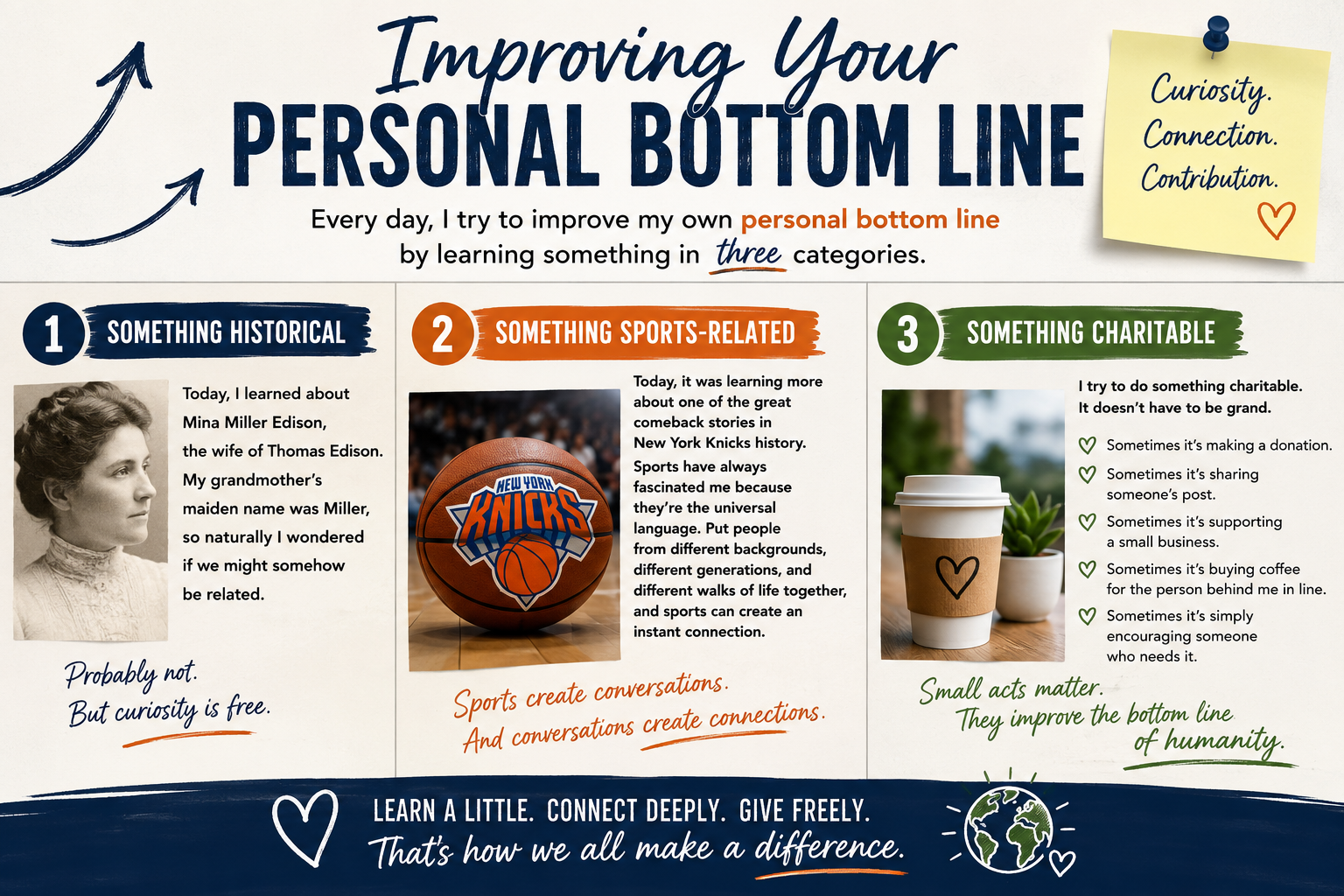
1. Something Historical
Today, I learned about Mina Miller Edison, the wife of Thomas Edison. My grandmother’s maiden name was Miller, so naturally I wondered if we might somehow be related.
Probably not.
But curiosity is free.
2. Something Sports-Related
Today, it was learning more about one of the great comeback stories in New York Knicks history. Sports have always fascinated me because they’re the universal language. Put people from different backgrounds, different generations, and different walks of life together, and sports can create an instant connection.
Sports create conversations.
And conversations create connections.
3. Something Charitable
I try to do something charitable.
It doesn’t have to be grand.
Sometimes it’s making a donation.
Sometimes it’s sharing someone’s post.
Sometimes it’s supporting a small business.
Sometimes it’s buying coffee for the person behind me in line.
Sometimes it’s simply encouraging someone who needs it.
Small acts matter.
They improve the bottom line of humanity.
The Common Thread
When I think about the people who have had the greatest impact on my life, they all have one thing in common:
They added value wherever they went.
They made businesses better.
They made teams better.
They made families better.
They made communities better.
They made other people better.
That’s relevance.
That’s leadership.
That’s influence.
And unlike money, titles, or status, it’s something every one of us can choose to build.
A Question Worth Asking
So here’s a question worth asking yourself:
What value am I adding?
Not tomorrow.
Not next year.
Today.
Because my mom taught me that everyone talks about the bottom line.
Very few people spend their lives improving it.
The real question isn’t whether you’re relevant.
The real question is: